

Swimwear Product Development Guide
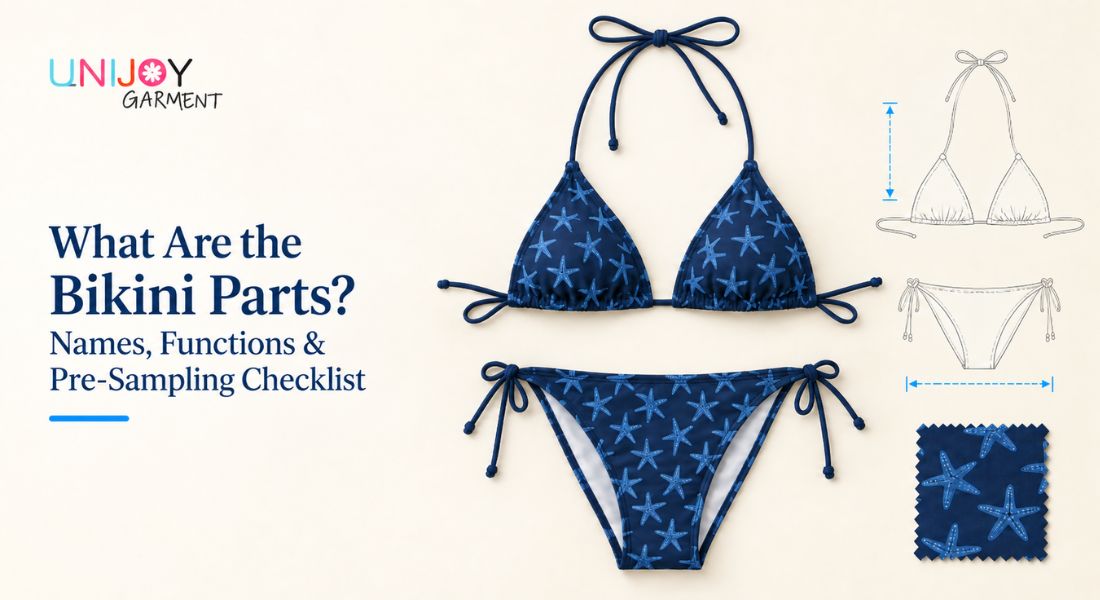
A bikini reference image can look clear, but the first sample may still come back with a different cup shape, strap position, rise, or coverage than you expected. A style name or front-view image cannot show every construction detail. This guide helps you identify the main parts of a bikini, understand how they affect the design, and spot missing details before sampling begins.
Table of Contents
What Are the Main Parts of a Bikini?
Use the table as a quick map of the main areas in a bikini top and bottom; the sections that follow explain how they affect the design and where similar terms differ.
| Bikini Part | Located on | Main details |
|---|---|---|
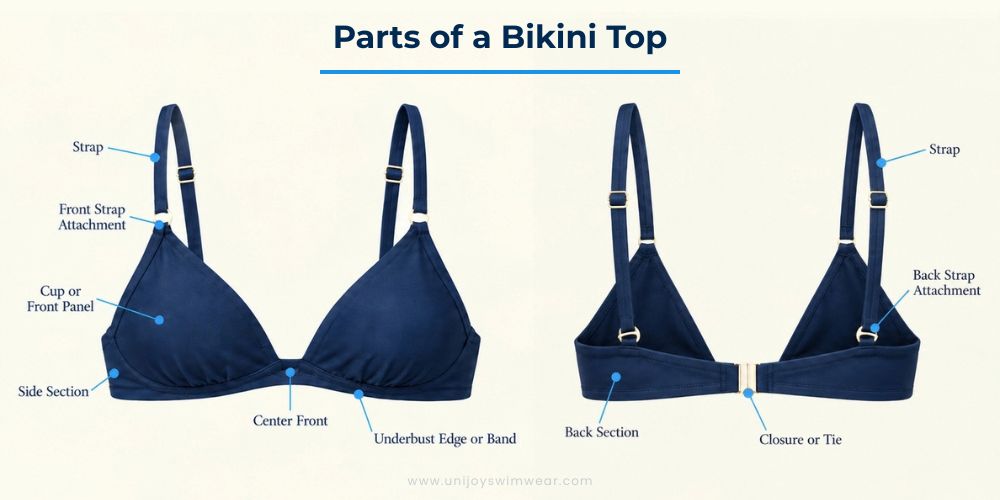
| Cup or front-panel area | Top | Cup form, front coverage and optional internal structures |
| Center front | Top | Continuous front, connector, tie or bridge |
| Underbust, sides and back | Top | Lower edge, optional band, side and back sections |
| Straps and closures | Top | Straps, ties, attachment points and optional closures |
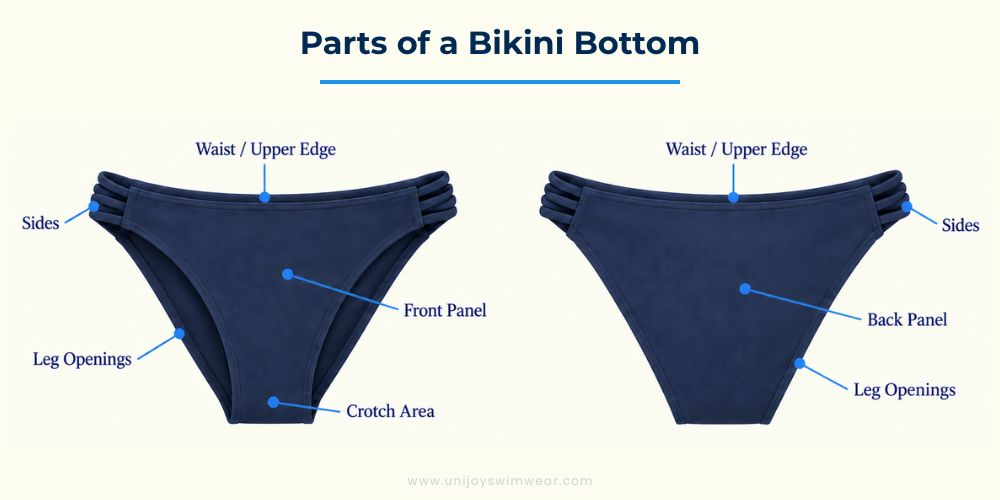
| Front and back panels | Bottom | Main front and back coverage areas |
| Waist and rise | Bottom | Upper-edge construction and wearing height |
| Sides | Bottom | Side height, seams, straps or ties |
| Leg openings | Bottom | Leg-line shape and hip coverage |
| Crotch area | Bottom | Crotch width, inner lining and optional gusset piece |
Parts of a Bikini Top
Cup or Front-Panel Area
Cup refers to the bust-covering section when the design has defined left and right areas. It does not automatically mean foam, molding or underwire is present. For a continuous bandeau or crop-style top, front panel is often the clearer name.
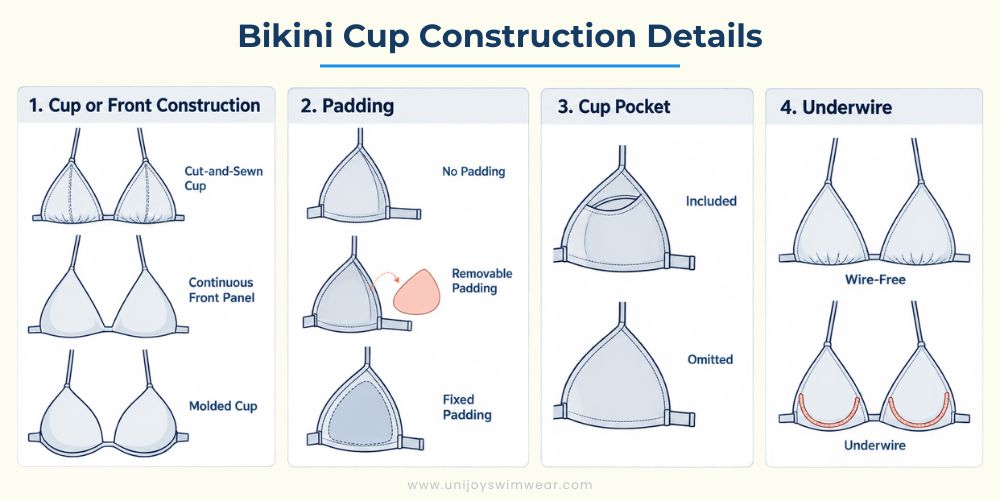
Cup construction usually combines several details:
| Detail | Common options | What it changes |
|---|---|---|
| Cup or front form | Cut-and-sewn cups, continuous front panel or molded cups | How the front is shaped and assembled |
| Padding | No padding, removable pads or fixed padding | Opacity, contour and thickness |
| Cup pocket | Included or omitted | Whether a removable insert can be added or removed |
| Wire | Wire-free or underwire | The support structure beneath a defined cup |
These details can be combined. A molded cup is pre-shaped and normally fixed inside the top. It helps create a more defined contour, but it may be wire-free or combined with underwire. A cut-and-sewn fabric cup may be unpadded, use fixed padding, or include a pocket for removable pads. The level of support depends on the cup construction, underbust, straps, back construction, and overall fit.
Underwire is a separate component placed in a channel below the cup. Its shape and size need to work with the cup pattern and surrounding construction. These internal choices may not be visible in a reference image.
Center Front
The center front is the area between the left and right sides of a bikini top. Depending on the design, this area may use continuous fabric, a tie, a ring, or a fabric connector.
Bridge has a more specific meaning. It is a distinct central section that connects two defined cups. A ring connector or continuous front panel is not necessarily a bridge. This distinction helps you describe what is actually in the design instead of applying a bra term to every bikini top.
Underbust, Sides and Back
Below the front panel, the lower edge may be finished directly or extended into a separate underbust band. From there, the side and back sections wrap around the torso. Some designs continue as fabric ties; others join at a back closure or form a pull-on shape.
Width, stretch and placement across this area influence how tension is distributed. Side boning, when used, is usually positioned beside the cup or along the side seam. It is different from underwire, which follows the lower edge of the cup. Mark the position and length of any boning on the design instead of describing the top only as having more support.
Straps and Closures
Straps may pass over the shoulders, tie behind the neck, or cross at the back. They can be fixed or adjustable. When describing the straps, include where they attach at the front and back, not just their visible shape.
Closures also vary. Ties, hooks and clasps open the top in different ways, while a pull-on top has no separate closure. Rings or sliders may be functional, decorative or both. When you review the hardware, identify whether each component connects, opens, adjusts, or simply decorates the top.
Parts of a Bikini Bottom
Front and Back Panels
The front and back panels provide the main coverage. Each panel may be cut as one piece or divided by seams, yokes, or gathered sections. A center-back seam can add shaping, while ruching gathers the fabric and changes the fit and appearance.
Coverage labels are not standardized. Cheeky, Brazilian, and full coverage can mean different widths across brands and markets. When developing a bikini line, you should compare the panel shape, width, back coverage, and reference size, not just the name.
Waist and Rise
At the upper edge, a bikini bottom may be finished with enclosed elastic, a separate waistband, or a fold-over band. Rise tells you how high the bottom extends from the crotch to the upper edge. Low-, mid-, and high-rise describe the general wearing position of bikini bottoms. A fold-over waistband can also adjust the wearing height and coverage.
To control the fit, you should confirm the front and back rise measurements. If you use a separate or fold-over band, include its finished height and whether it can be worn in more than one position.
Sides
Between the front and back panels, the sides may be regular seams, narrow fabric sections, fixed straps, adjustable ties or hardware connections. Their height and width affect how much of the hip is covered and how the upper edge meets the leg opening.
When you review a tie-side bottom, check whether tightening the ties also changes the front and back coverage or simply holds fixed panels in place. A front image may not make that difference clear, so it is worth checking the back or side view as well.
Leg Openings
The leg openings form the lower curves around the legs. A higher cut usually exposes more of the hip and creates a longer leg line, while a lower cut provides more coverage.
High-cut tells you about the leg line, but not how high the upper edge sits or how much back coverage the bottom provides. Two high-cut bottoms can still fit very differently, so you should compare both the front and back views rather than relying on the label alone.
Crotch Area
The crotch area is the narrowest part of a bikini bottom and connects the front and back panels. Its width and shape affect the fit. Most bikini bottoms have an inner crotch lining for comfort and coverage, while some patterns also include a separate gusset piece.
If the brand, target market, or order requires a hygiene protection sticker, specify its material, size, position, and whether it must be removable. This is an order-specific packaging requirement rather than a standard part of every bikini bottom.
How Fabric and Lining Choices Affect Bikini Parts
Outer Fabric
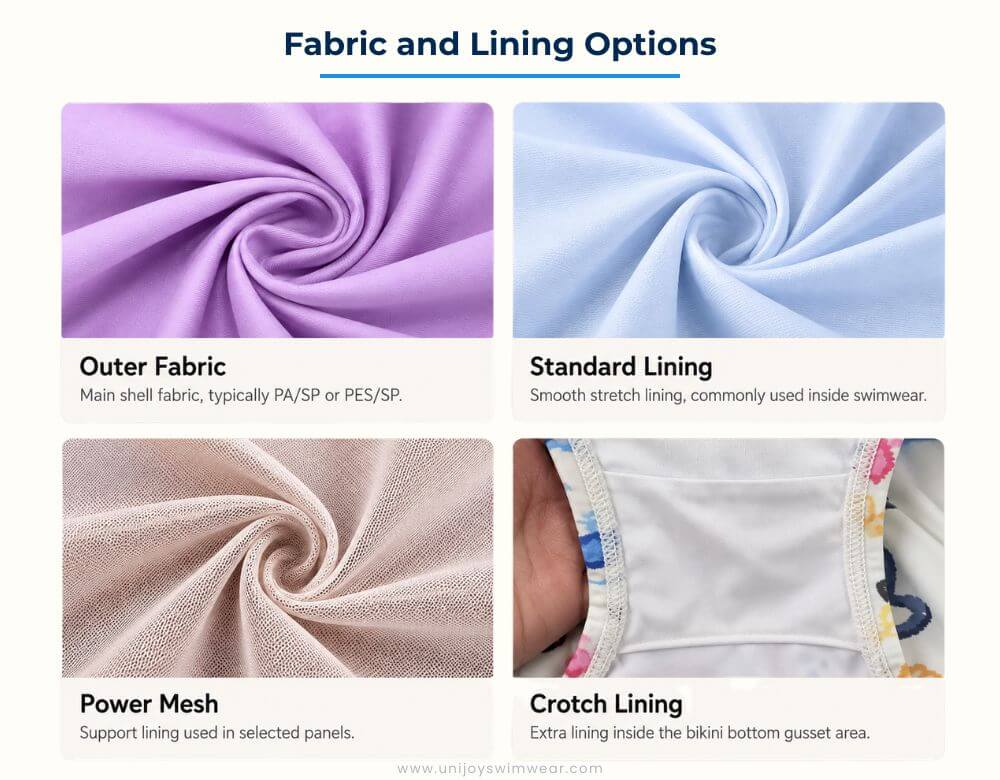
The two most common swimwear fabric blends are nylon/spandex and polyester/spandex. Recycled nylon/spandex and recycled polyester/spandex are also available, while polyester/PBT fabrics are often chosen for training or frequent pool use when greater chlorine resistance and shape retention are needed.
When choosing a fabric, start with where and how the bikini will be worn. Check the actual material for stretch and recovery, hand feel, weight, opacity, colorfastness, and print suitability rather than relying on the fiber name alone.
Lining
Lining may cover the whole garment, selected panels, or only the crotch area of a bikini bottom. Common options include self lining, which uses the outer fabric; standard stretch lining, a lighter dedicated lining material; and power mesh, used as an internal layer where extra support is needed.
Depending on the design, the lining may use one or more layers, and its color may match or contrast with the outer fabric. For pale colors, check the sample when it is both dry and wet.
How Are Bikini Parts Finished and Assembled?
Elastic and Edge Finishes
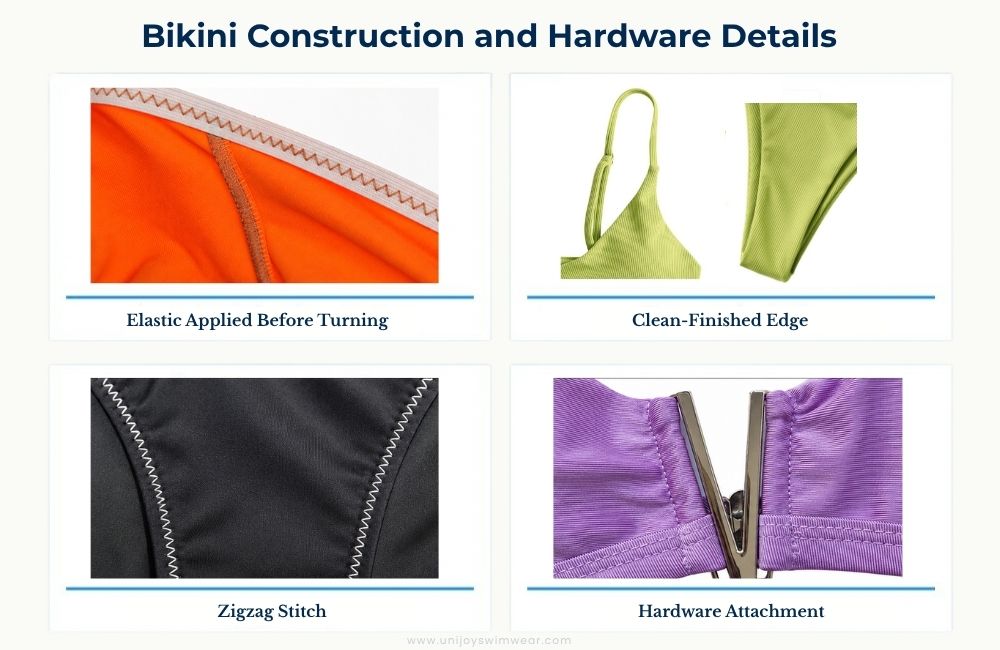
Elastic helps the bikini stay close to the body and return to shape after stretching. It is commonly used around the underbust, waist, and leg openings, and may also be used inside straps. Its width and tension need to work with the fabric and intended fit.
Edges may be turned, bound, or clean-finished, and one bikini can use more than one method. When you check a sample, look for edges that lie flat without gaping, twisting, or digging into the body.
Seams and Assembly
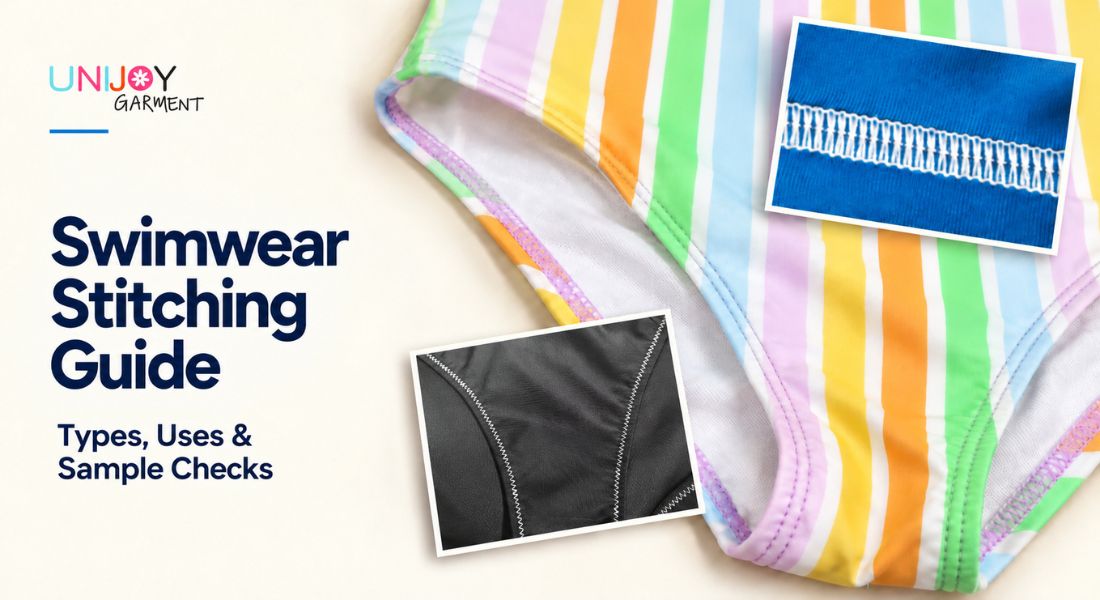
Overlock, zigzag and coverstitch applications, as well as flatlock construction, are possible ways to join or secure stretch materials. The suitable choice depends on the fabric, stretch, seam location, and finished appearance.
If you are developing a reversible or clean-finished bikini, decide early how the seams, openings, and labels will be handled, because the internal construction needs to remain hidden or neat.
Hardware and Trims
Rings, sliders, clasps, hooks, cord ends, logo plates, and decorative trims can connect parts, adjust the fit, or add visual detail. If you use them, confirm the size, color, finish, and attachment method.
For styles intended for regular pool or saltwater use, do not rely on the material or coating name alone. Identify the component to be checked, the agreed method and conditions, and the result that will be considered acceptable for discoloration, corrosion, or coating damage.
Turn a Bikini Reference into a Pre-Sampling Checklist
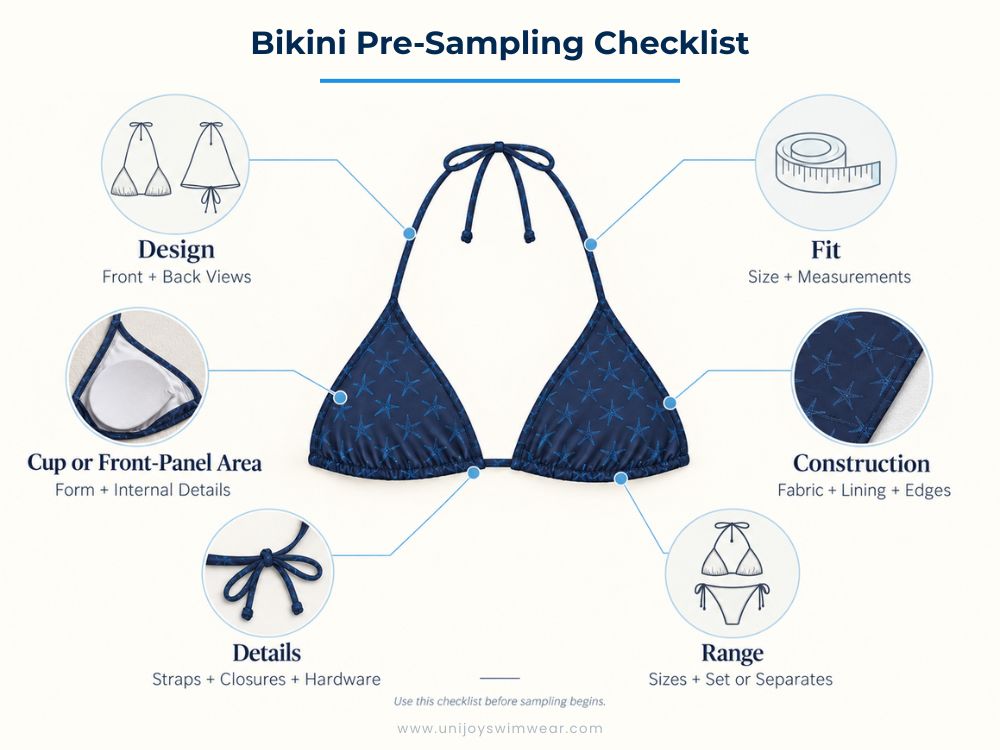
A reference communicates the look. Clear product information explains how that look is built. Before sampling, review the design through six areas so missing decisions become visible early.
| Area | What to confirm |
|---|---|
| Design | Front and back drawings or clear reference images |
| Fit | Reference size, measurement points, front and back rise, and coverage |
| Cup or front-panel area | Cup form, padding, cup pocket, underwire and desired support |
| Construction | Fabric, lining, elastic, seams and edge finish |
| Details | Straps, closures, hardware, print and logo placement |
| Range | Size range, grading basis and whether tops and bottoms are set or separate SKUs |
Example: Triangle Bikini Top
A triangle bikini top shows why the style name alone is not enough. “Triangle” describes the silhouette, but it does not tell you whether the padding is removable or fixed, how the straps adjust, or how the top closes.
Record these decisions in your tech pack. You can also use the checklist above to review an existing tech pack, sketch, or design file.
Bikini Parts FAQ
From Bikini Parts to a Clear Product Brief
Knowing the names of bikini parts turns a visual idea into language others can follow. A workable product brief still needs the relevant construction, material and measurement information.
Developing a new bikini style? Share your sketch, reference images or tech pack with UNIJOY. We can help you clarify the construction, materials and measurements before the first sample is made.