

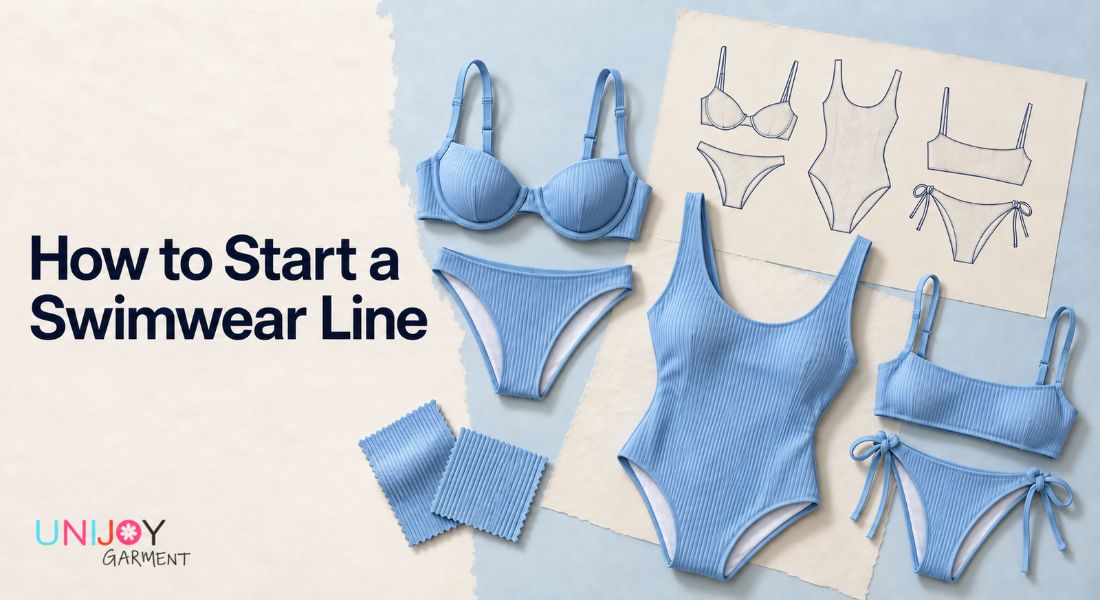
You have an idea for a swimwear line. Should you start with designs, fabrics, or finding a manufacturer?
Start by deciding who you want to sell to and why they would choose your collection. That gives your first styles a direction and helps you judge what you can afford to develop. These eight steps take you from that first decision through sampling, production, and launch.
À UNIJOY, we have been manufacturing swimwear in China since 2008, working with over 100 clients—from first-time founders to established swimwear brands. This guide draws on our experience in product development, sampling, and bulk production.
| Stage | What you should have at the end |
|---|---|
| 1. Validate | A defined customer need and an initial price and channel direction |
| 2. Plan | A provisional first collection and quantity mix |
| 3. Budget | An initial budget, target price, and launch window |
| 4. Brief | Clear product requirements to discuss with a development partner |
| 5. Source | A suitable production route and comparable supplier responses |
| 6. Sample | Tested designs, recorded changes, and remaining approval items |
| 7. Produce | A confirmed order, quality checks, and a delivery plan |
| 8. Launch | Accurate product information and a way to learn from first sales |
1. Know Your Customer
Define Your Customer and Their Needs
“Swimwear for women” is too broad to guide a first collection. Picture who will wear it and where: someone who swims regularly, travels to a resort, or wants more coverage while moving in the water. Then decide why that person would choose your line. The answer could be better fit or support, a distinctive look, coordinated pieces, or a style that suits a particular occasion.
Put that reason into one sentence you can use when choosing designs. “A small resort collection with colors that work together” gives you more direction than “fashionable swimwear.”
Check Demand for Your Idea
Read reviews of comparable products to see what buyers praise, what they wish were different, and which options they struggle to find. Talk to people you hope will buy your swimwear: ask what they have bought, why they chose it, and what they would buy again. Compare those answers with the products already available. Repeated comments are useful clues, though they do not tell you how large the market will be.
Note the approximate price range your customer might consider and where you expect to sell first, such as your own online store or wholesale accounts. You will use both when you check costs and decide how broad the first collection should be.
2. Plan Your First Collection
Choose Your Styles, Colors, and Sizes
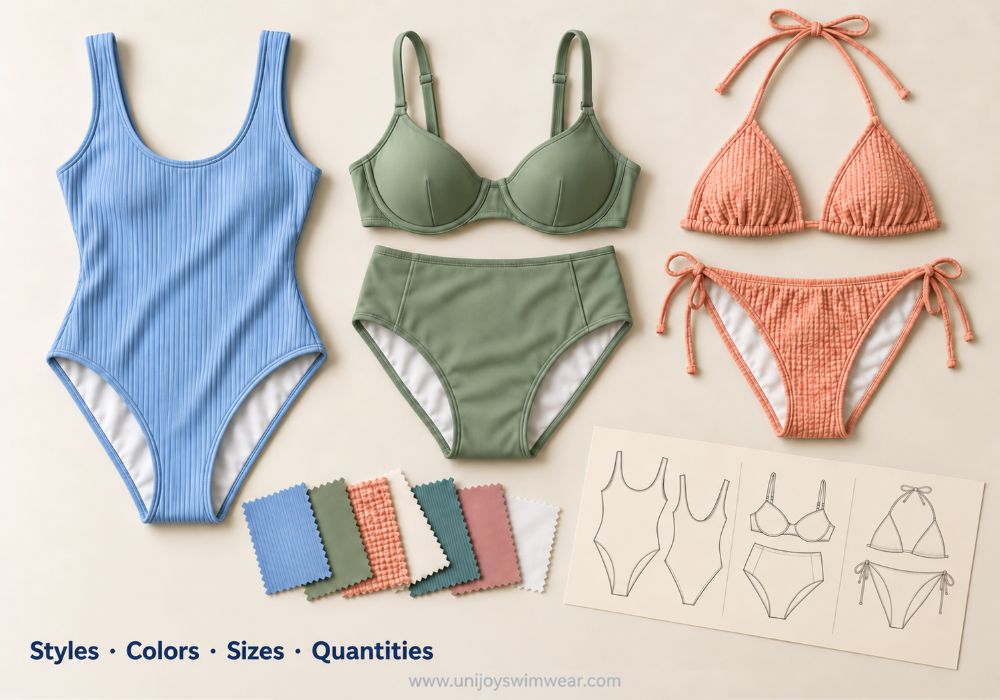
Choose a lead style and the pieces that belong beside it. If a coordinated look is your distinction, pick colors and cuts that work together instead of adding an unrelated trend piece. The aim is a first range customers can recognize as one collection.
Decide which swimsuit styles, colors or prints, and sizes you intend to offer. Every additional option needs development work, stock, and photography, so give each one a clear role. Keep the initial range focused enough that you can see what customers respond to.
Plan Your First Order Quantities
Estimate how many units you need for each style and color, then distribute those units across the proposed sizes. Check whether the mix reflects your customer and sales channel rather than dividing every option equally by habit.
An order’s total unit count is different from a swimwear supplier’s minimum order quantity (MOQ) per style or color. If you add another color without increasing the total order, the units allocated to each color may fall below the supplier’s requirement and leave stock spread too thinly. These quantities are a starting point. Revisit them after you learn the applicable minimums, material availability, and prices.
3. Set Your Budget and Timeline
Estimate Your First-Run Costs
Build an initial budget around your planned styles and quantities. Include development, samples and revisions, production, any separately charged labels or packaging, applicable testing, shipping and import charges, and launch photography or sales materials. Use rough estimates or indicative supplier price ranges at this stage, and leave room for changes. Later, as you receive quotes, check what is already included so you do not count the same cost twice.
Costs will change with the route you choose: adapting an existing design and developing an original style do not involve the same amount of sample work.
Check Your Pricing
Start with the price range your target customers would consider and where you plan to sell. Estimate the product’s landed cost—the cost of getting sellable stock to its destination—and consider the fees or margin your sales channel requires. If your planned selling price does not cover those costs, do not assume higher sales volume will fix the gap. Reconsider the design complexity, option count, quantity mix, channel, or positioning before you commit to production.
Work Backward from Launch
Starting with your intended launch, allow time for development discussions, sample rounds and fit changes, order approvals, production, quality checks, transport, and receipt. Include enough flexibility to resolve issues found in a sample or before shipment. Treat your first launch date as an estimate. Update it once a manufacturer confirms the development, production, and delivery schedule.
Separately, ask qualified advisers or the relevant authorities to confirm the business-registration, brand and trademark, tax, labeling, and product-compliance requirements that apply to your operating location, sales markets, and products.
4. Prepare Your Product Brief
Gather References and Product Details
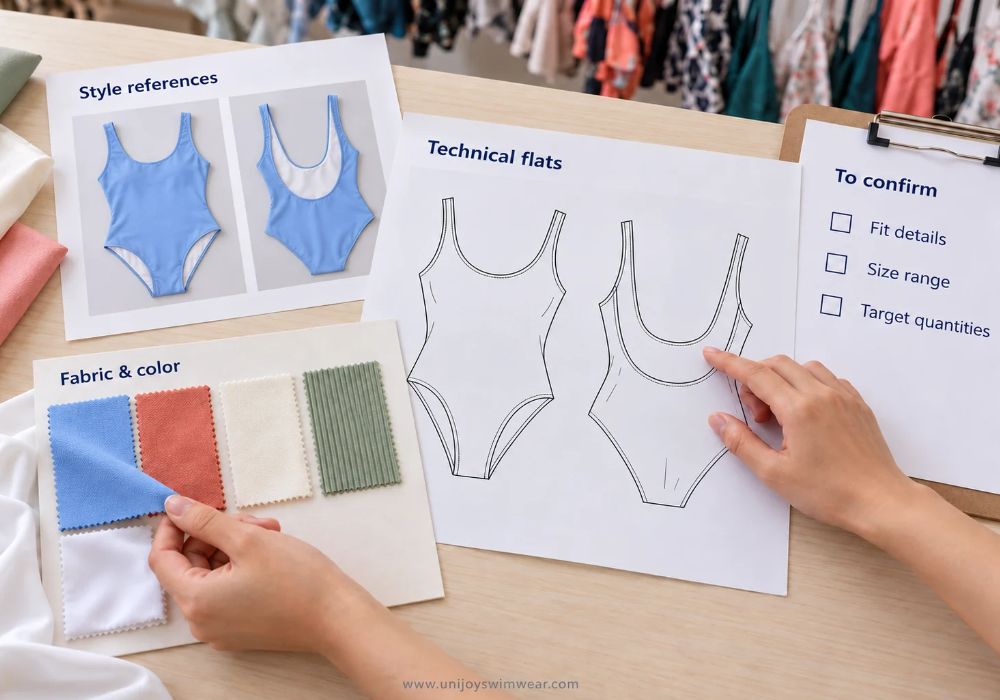
For each proposed style, assemble sketches, annotated reference images, or a physical sample that shows the direction you want. Describe the silhouette and design details, intended sizes and colors, estimated quantities, target market, and how the suit will be used. If a reference is another brand’s product, identify the feature you are discussing rather than asking a partner to copy the design.
Mark what is decided and what still needs development. You can contact a development partner without a complete tech pack—a document that specifies a product’s construction and measurements. Your sketches or references can start the conversation; you can work through missing details before expecting a firm quote or approving production.
Describe Fit, Coverage, and Material Needs
Explain what the wearer should experience, not only what the suit should look like. Describe the coverage and support you want during the intended activity. For matériaux pour maillots de bain, note the feel you want against the skin, the stretch and recovery the design needs, and whether frequent pool use is expected. “The top should keep its coverage when the wearer raises her arms” gives a development partner more to work with than “comfortable fit.”
Make clear which details are essential and which you can change. You can discuss the right lining, trims, and construction with the development team as the design becomes more specific; you do not have to solve every technical detail in the first message.
5. Choose Your Production Partner
Compare Production Options
Your route depends on how distinctive the product must be, how much development help you need, your budget, and the volume you intend to buy. Adding your label to an existing design is generally a different project from altering an existing pattern; creating an original style requires more development decisions and sample work. Print-on-demand is another route for testing designs with little upfront inventory, but it offers a different level of product and production control from custom bulk manufacturing.
Ask potential partners which route they can support. If you want an original collection for bulk production, look for someone who can help develop the styles and carry the approved details into manufacturing.
Check Experience, MOQ, and Terms
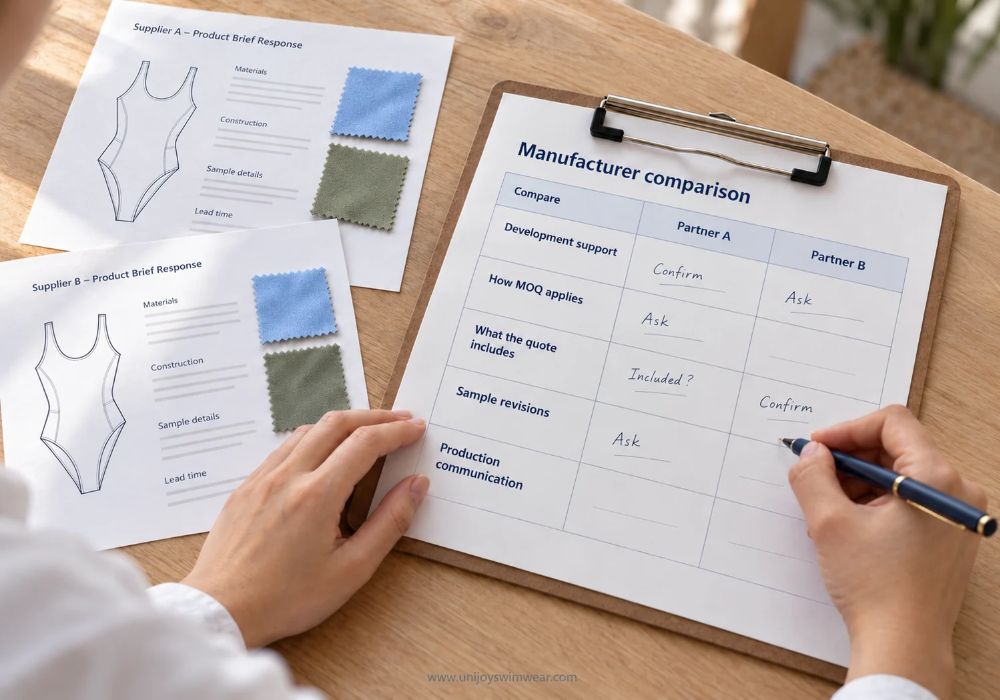
Send the same initial product brief to each fabricant de maillots de bain you are considering. Ask about their swimwear development and production experience, what technical work they can support, how minimum order quantities apply to your proposed styles and colors, what a quote covers, how samples are revised, and how production and delivery updates are handled. If a critical detail is still open, ask what information they need before they can price or schedule the work.
Make sure the quotes cover the same designs, materials, quantities, and delivery requirements. A lower quote may exclude development or required materials, or cover different packaging requirements. Check these differences before comparing prices. Use what you learn to revise the collection, budget, and launch window before choosing a partner.
6. Develop and Refine Your Samples
Check Fit, Coverage, and Comfort
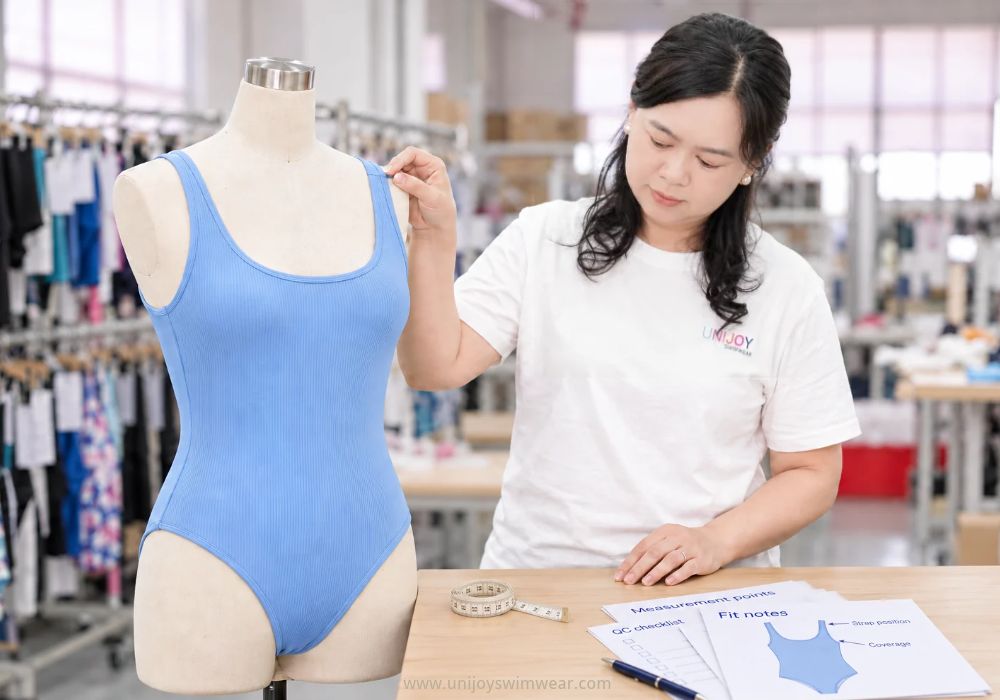
Compare each sample with your brief, then fit-test it on someone whose measurements match the sample’s intended size. Check how it fits while standing and moving, whether coverage stays in place, and whether it feels comfortable. If the suit is meant for swimming, check coverage, whether the fabric becomes see-through, and whether support changes when wet.
Check for problems such as lining that shifts, edges that dig in, or hardware that feels uncomfortable. A wear check helps you decide what to revise; it does not replace any product testing or market-specific compliance work your project may require.
Give Clear Sample Feedback
For each change, identify the location, describe what happened, explain the result you want, and attach an annotated photo where useful. For example: “The left shoulder strap slips when the wearer raises her arm; please review its length or attachment so it stays in place during movement.” That is more actionable than “the fit is wrong.”
When the revised sample arrives, check both the original issue and any nearby areas affected by the change. Keep a record of what was accepted and what remains open so a later revision does not quietly undo an earlier approval.
Confirm What You’ve Approved
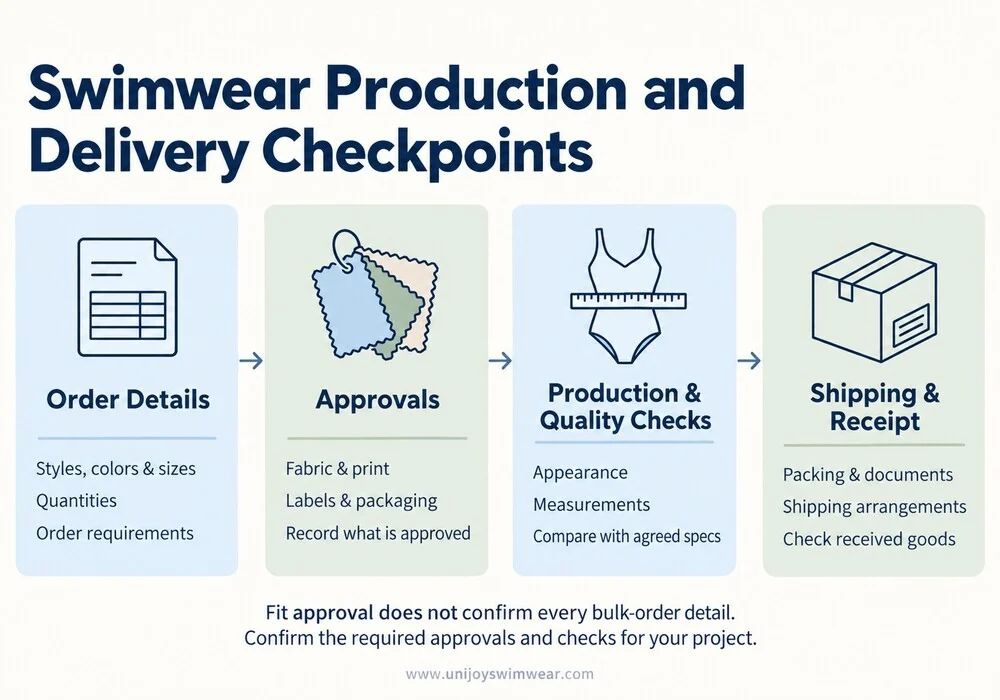
Approving the fit of one sample in one size does not approve every size or the final bulk fabric, color, labels, and packaging. Agree which size checks and other approvals are needed for your project before production. Record what you have approved and what still needs confirmation before production.
7. Manage Production and Delivery
Confirm the Order and Final Details
Once the design direction is settled, confirm the order’s styles, colors, size quantities, materials and trims, labels and packaging, price, delivery responsibilities, and agreed milestones. Identify which details still need approval before cutting or bulk production begins. Depending on the project, these may include a color, print, material, size set, or production sample.
If a pre-production (PP) sample is used, record exactly what it approves: the relevant style, construction, material, color, and any included labeling or packaging. The approval sequence should match the particular order rather than an assumed one-size-fits-all process.
Track Production and Check Quality
During production, follow the milestones agreed with your supplier and raise material, schedule, or workmanship issues when they appear. Agree in advance what will be checked during production or before shipment. Check quantities, appearance, swimwear measurements, labels, and packaging against your order and approved product specifications.
If you find an issue, document it, agree on the correction, and check the result before shipment. If testing or a third-party inspection is needed, agree on its scope in advance so everyone knows what will be checked.
Arrange Shipping and Check Delivery
Confirm the shipping arrangement, destination, expected receipt window, and who will provide the shipping details and documents. On receipt, check cartons and quantities against the order and record visible transit damage or product issues promptly. Build the actual receipt date into your launch plan: a factory completion date is not the date customers can buy your stock.
8. Launch Your Collection
Prepare Your Product Information
Prepare your chosen sales channel while the collection is being developed and produced. You will need accurate product images, size and fit guidance, material and care information, and clear shipping and return terms. Before launch, make sure your product information and fit guidance match the products you receive.
Learn from Sales and Feedback
After launch, look at sales by style and size, exchange and return reasons, and comments about fit, coverage, and wear. Use early sales and customer feedback to decide what to reorder, revise, or explain more clearly in the next run.
FAQs About Starting a Swimwear Line
Parlez-nous de votre projet de maillots de bain
If you’re planning custom swimwear development or bulk production, contact UNIJOY with your designs or references, target market, proposed styles and quantities, and target launch date. We can discuss the development and production requirements for your project.